
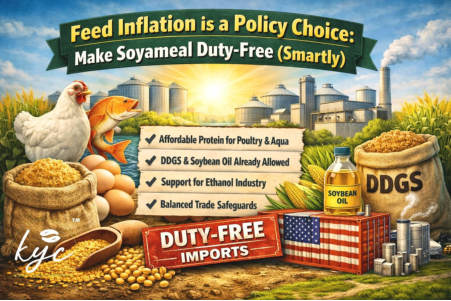
If India can allow duty-free Maize DDGS and is also opening space for soybean oil imports, then keeping soyameal behind a high non-tariff wall is more emotional than economics. Here’s the simple truth: India’s fastest-growing “protein consumers” are not humans — they are chickens and fish. Poultry and aquaculture need consistent, affordable, high-quality protein. When protein prices spike, the shock travels straight into egg, chicken and fish prices, and affordability to consumers weakens. So why soyameal matters: 1) Soyameal is the backbone protein of feed. It is the most widely used plant protein for balanced rations across poultry and aqua. When soyameal becomes expensive or volatile, feed formulators are forced to compromise—either on nutrition or on cost. Neither is good for farmers, integrators, nor consumers. 2) The GMO argument is already blurred by DDGS. If DDGS is coming in (and it will largely be GMO-linked in origin), then drawing a “GMO purity line” only on soyameal becomes inconsistent. Policy must be coherent: either define a clear, science-based framework for imports, or stop pretending one product is fundamentally different from the other. 3) The soybean sector impact is already larger via oil. Let’s be honest: if cheap soybean oil imports increase, crushing economics get stressed anyway. In that context, blocking soyameal doesn’t “save” soybean farmers—it simply changes where the pressure shows up. A tighter, more rational approach is to stabilise feed protein while designing safeguards for domestic crushers and farmers.
4) Cheaper, better imported DDGS will reduce soyameal demand anyway. DDGS is not just a substitute; high-quality DDGS can be used at higher inclusion rates than many domestic lots. That means even without permitting soyameal imports, soyameal consumption can fall as rations pivot to DDGS. So keeping soyameal restricted does not protect demand the way many assume. 5) This also creates anxiety for India’s grain-ethanol industry. Domestic ethanol plants depend on DDGS realisations to support unit economics. If feed users shift to duty-free imported DDGS, it can compress domestic DDGS prices—hurting an ecosystem we are simultaneously trying to scale. Our view: allow duty-free soyameal—but do it smartly. Not a free-for-all. A precision instrument: Time-bound TRQ (limited quantity + defined window) Price-trigger safeguard (auto-duty if domestic prices crash) Strong quality specs (esp. toxin and protein parameters) Clear GM/non-GM disclosure and compliance rules India doesn’t need ideology in feed policy. It needs lower feed inflation, stable protein availability, and predictable rules—while protecting farmers through smarter instruments than blanket bans.